
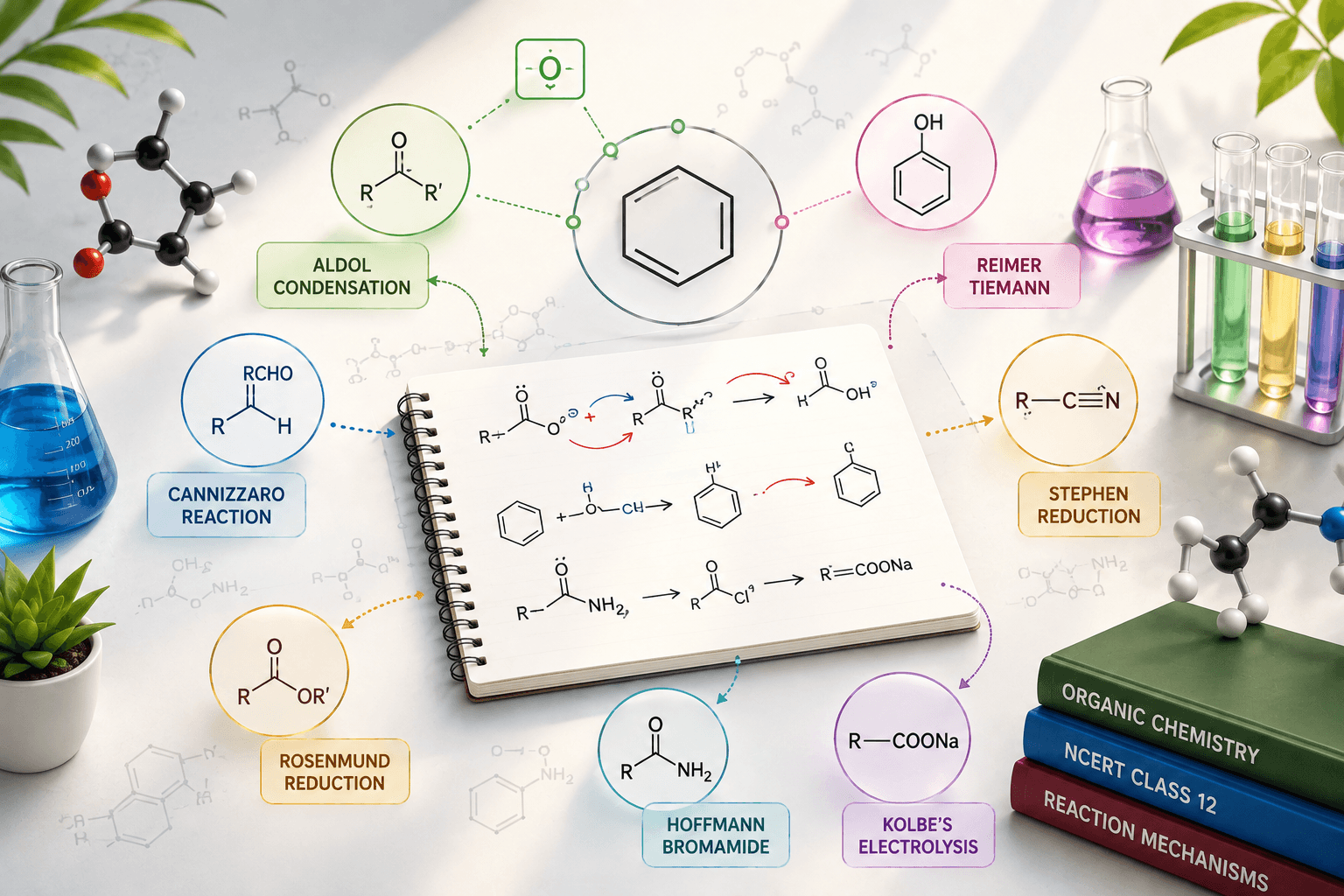
Organic Chemistry Named Reactions Cheat Sheet for NEET & JEE: Master Mechanisms & Reagents
Examifly
ExamiFly Educator
Table of Contents4
🧪 100% NCERT CLASS 12TH CHEMISTRY VERIFIED
✍️ Authored by Examifly Academic Team | 🔬 Reviewed by Senior Organic Chemistry Faculty & Ex-IITian Mentor | Updated for Latest NTA Pattern
For competitive aspirants, Organic Chemistry often feels like an overwhelming catalog of names, reagents, and reaction conditions. Searching for an Organic Chemistry named reactions cheat sheet for NEET and JEE is common because memorizing 35+ reactions individually without understanding their underlying mechanisms leads to immediate confusion on multi-step conversion questions.
Named reactions are not random historical facts—they are standardized chemical transformations governed by clear electron-pushing rules. In the latest NTA papers, questions rarely ask for straightforward direct definitions. Instead, they test whether you can identify how a specific reagent (like DIBAL-H, PCC, or CHCl3/KOH) alters a functional group within a 3-step synthesis chain. Mastering these reactions systematically is the fastest way to secure 45–60 marks in Chemistry.
Why Rote Memorization Fails in Organic Chemistry (The Reagent-Substrate Logic)
Memorizing reactions as raw text ("") causes major breakdowns during exams because NTA modifies the starting substrate with bulky alkyl groups, aromatic rings, or competing functional groups.
The Electrophile-Nucleophile Electronic Core
Every named reaction in Class 12th NCERT boils down to a simple interaction:
- Identify the Nucleophile: Electron-rich species (Carbanion, enolate ion, lone pair on Nitrogen/Oxygen).
- Identify the Electrophile: Electron-deficient species (Carbonyl carbon C=O, Carbocation, Alkyl halide carbon).
- Analyze the Reagent's Mandate: Is it a base removing an acidic -hydrogen (Aldol), a reducing agent targeting esters specifically (DIBAL-H), or a carbene generator (Reimer-Tiemann)?
┌────────────────────────────────────────────────────────────────────────┐
│ THE ORGANIC REACTION DECODER │
│ │
│ [Substrate] ──► Identify Electron Density (Electrophile/Nucleophile)│
│ │ │
│ ▼ │
│ [Reagent] ──► Acid/Base, Oxidizing, Reducing, or Halogenating │
│ │ │
│ ▼ │
│ [Product] ──► Predict Regioselectivity (Markovnikov, Anti, etc.) │
└────────────────────────────────────────────────────────────────────────┘
Distribution of Named Reactions in NEET & JEE Main
| Exam | Direct Named Reaction Questions | Multi-Step Synthesis / Reagent Questions | Total Marks Contribution |
|---|---|---|---|
| NEET Chemistry | 4–6 Questions | 8–10 Questions | 48–64 Marks (30–35% of Chemistry) |
| JEE Main Chemistry | 2–3 Questions | 6–8 Questions | 32–44 Marks (30–40% of Chemistry) |
Top High-Yield Named Reactions Master Table (Class 12th NCERT)
Instead of memorizing long chemical paragraphs, use this comprehensive conversion table to quickly identify the starting material, required reagents, and key intermediate for the most frequently tested NCERT named reactions.
Master Named Reactions Matrix
| Reaction Name | Starting Substrate | Reagents & Conditions | Major Product | Key Intermediate / Reactive Species | NTA Trap / Exception to Remember |
|---|---|---|---|---|---|
| Aldol Condensation | Aldehydes/Ketones with -H | Dilute NaOH or Ba(OH)2, followed by | ,-unsaturated aldehyde/ketone | Enolate ion (Carbanion) | Substrates with zero -H (e.g., Benzaldehyde, Formaldehyde) cannot undergo self-aldol; they undergo Cannizzaro or Cross-Aldol instead. |
| Cannizzaro Reaction | Aldehydes with no -H | Concentrated KOH or NaOH (), | 1 molecule Alcohol +1 molecule Carboxylate salt (Disproportionation) | Hydride ion (H-) transfer (Slowest / RDS step) | In Cross-Cannizzaro with Formaldehyde (HCHO), Formaldehyde is always oxidized to formate salt; the other aldehyde is reduced to alcohol. |
| Reimer-Tiemann Reaction | Phenol | CHCl3+aq.KOH at 340K, followed by H+ | Salicylaldehyde (o-hydroxybenzaldehyde) | Dichlorocarbene (:CCl2) (Electrophile) | If CCl4 is used instead of CHCl3, the major product formed is Salicylic acid instead of Salicylaldehyde. |
| Kolbe’s Reaction | Phenol | 2. CO2 (400K,4--7atm) 3. H+ | Salicylic acid (o-hydroxybenzoic acid) | Phenoxide ion (Highly activated ring) | Electrophile is weak (CO2); reaction fails with benzene. Ortho-isomer predominates due to intramolecular hydrogen bonding. |
| Hoffmann Bromamide Degradation | 1 Acid Amide (R-CONH2) | Br2+4NaOH (or NaOBr) | 1 Amine with one less carbon (R-NH2) | Alkyl isocyanate (R-N=C=O) / Nitrene intermediate | Fails with 2 or 3 amides. Consumes exactly 4molesofNaOH and 1moleofBr2 per mole of amide. |
| Gabriel Phthalimide Synthesis | Phthalimide | 1. ethanolicKOH 2. R-X(Alkylhalide) 3. aq.NaOH(Hydrazinolysis) | Pure 1 Aliphatic Amine | Phthalimide anion (N- nucleophile) | Cannot prepare Aromatic 1 amines (Aniline) because aryl halides do not undergo SN2 nucleophilic substitution. |
| Rosenmund Reduction | Acyl Chloride (R-COCl) | H2,Pd/BaSO4+Quinoline/Sulfur | Aldehyde (R-CHO) | Acyl cation intermediate | BaSO4 acts as a catalytic poison to prevent further reduction of the aldehyde into a primary alcohol. |
| Clemmensen Reduction | Aldehydes / Ketones (C=O) | Zn-Hg+conc.HCl | Alkane (-CH2-) | Zinc carbenoid / Radical intermediate | Fails if acid-sensitive groups (e.g., -OH, -OCH3, C=C) are present on the substrate; they will react with concentrated HCl. |
| Wolff-Kishner Reduction | Aldehydes / Ketones (C=O) | 1. NH2NH2(Hydrazine) 2. KOH/Ethyleneglycol, | Alkane (-CH2-) +N2 | Hydrazone Carbanion intermediate | Fails if base-sensitive groups (e.g., alkyl halides, esters) are present on the substrate. |
| Williamson Ether Synthesis | Alkyl Halide (R-X) + Sodium Alkoxide (R'O-Na+) | Dry Ether, Heat | Ether (R-O-R') | SN2 backside attack | Alkyl halide must be strictly 1. If a 3 alkyl halide is used, elimination (E2) dominates completely, yielding an alkene. |
The Reagent Master Matrix: Oxidizing & Reducing Selectivity
Most multi-step organic questions in NEET and JEE Main test whether you can predict the exact selectivity of competitive reagents.
┌────────────────────────────────────────────────────────────────────────┐
│ REAGENT SELECTIVITY SUMMARY CHEAT │
│ │
│ Aldehyde from 1 Alcohol ──► Use PCC or CrO3 in CH2Cl2 │
│ Aldehyde from Ester / Nitrile ──► Use DIBAL-H at -78°C │
│ Alkane from Carbonyl (Acidic) ──► Use Zn-Hg / conc. HCl │
│ Alkane from Carbonyl (Basic) ──► Use NH2NH2 / KOH, Glycol │
│ Acid from Alkyl Benzene ──► Use Alkaline KMnO4, Heat │
└────────────────────────────────────────────────────────────────────────┘
Reducing Agent Selectivity Chart
| Functional Group | LiAlH4 (Lithium Aluminium Hydride) | NaBH4 (Sodium Borohydride) | DIBAL-H (Diisobutylaluminium Hydride) | H2 / Pd-C |
|---|---|---|---|---|
| Aldehydes & Ketones | Reduces to 1/2 Alcohol | Reduces to 1/2 Alcohol | Reduces to 1/2 Alcohol | Reduces to 1/2 Alcohol |
| Carboxylic Acids (-COOH) | Reduces to 1 Alcohol | No Reaction (Zero Reduction) | No Reaction | No Reaction (Under mild conditions) |
| Esters (-COOR) | Reduces to 2 Alcohol molecules | No Reaction (Zero Reduction) | Selectively forms Aldehydes (at ) | No Reaction |
| Acid Chlorides (-COCl) | Reduces to 1 Alcohol | Reduces to 1 Alcohol | Forms Aldehydes | Forms Aldehydes (with Pd/BaSO4) |
| Nitriles () | Reduces to 1 Amine (-CH2NH2) | No Reaction | Selectively forms Aldehydes (after H3O+) | Reduces to 1 Amine |
| Isolated C=C Double Bond | No Reaction (Preserves Double Bond) | No Reaction | No Reaction | Reduces completely to Alkane |
Oxidizing Agent Selectivity Guide
- **Mild Oxidizers (PCC, Collin's Reagent, Cu/573K):**Converts 1 Alcohols into Aldehydes (stops oxidation without forming carboxylic acids).Converts 2 Alcohols into Ketones.Converts 3 Alcohols with Cu/573K into Alkenes via dehydration.
- **Strong Oxidizers (Alkaline KMnO4, Acidic K2Cr2O7, Jones Reagent):**Converts 1 Alcohols and Aldehydes into Carboxylic Acids.Converts any alkyl side-chain on a benzene ring possessing at least one benzylic hydrogen into Benzoic Acid (Ph-COOH).
💡 TRY IT LIVE ON EXAMIFLY
Stuck on Organic Multi-Step Conversions for NEET/JEE?
Stop memorizing reaction textbooks line-by-line. Practice bite-sized reaction pathways, reagent elimination tricks, and instant mechanisms in under 3 minutes.
👉 Try 1 Free Interactive AI Practice Bite on Aldehydes, Ketones & Reagents →
Step-by-Step Mechanism Traps & Solved Multi-Step PYQ Breakdown
In competitive exams like NEET and JEE Main, NTA rarely asks isolated one-step reactions. Instead, questions present a 3-to-4 step synthetic sequence where misidentifying a single intermediate completely derails your final product selection.
The Classic Cross-Aldol vs. Cannizzaro Diagnostic Flowchart
When an unknown carbonyl compound is treated with a strong base (like NaOH or KOH), use this rapid 3-step decision protocol:
[ Carbonyl Substrate + Base (OH⁻) ]
│
Does the substrate have any α-Hydrogen?
│
┌────────────────┴────────────────┐
YES NO
│ │
Is it dilute base (10%)? Is it concentrated base (50%)?
│ │
▼ ▼
[ ALDOL REACTION ] [ CANNIZZARO REACTION ]
Enolate Ion Formation Hydride (H⁻) Shift / Redox
Forms β-Hydroxy Aldehyde/Ketone Forms 1 Alcohol + 1 Acid Salt
Solved JEE Main / NEET Multi-Step Conversion PYQ
NTA Pattern Problem:
Identify compounds [A], [B], and [C] in the following reaction sequence:
Step-by-Step Solution & Elimination Strategy:
- Step 1: Free Radical Benzylic ChlorinationReagent: Cl2 in presence of light (h) targets the benzylic position via free radical substitution (not the aromatic ring).Product [A]: Benzyl chloride (C6H5CH2Cl).
- Step 2: Nucleophilic Substitution (SN2)Reagent: aq.KOH supplies OH-, displacing the chloride ion.Product [B]: Benzyl alcohol (C6H5CH2OH).
- Step 3: Oxidation / Cannizzaro Disproportionation TrapIf [B] is oxidized to Benzaldehyde (C6H5CHO), treating it with initiates the Cannizzaro Reaction (because Benzaldehyde possesses zero -hydrogens).Products [C] & [D]: Disproportionates into Benzyl alcohol (C6H5CH2OH) and Sodium benzoate (C6H5COO-Na+).
Frequently Asked Questions
Which named reactions carry the highest weightage in NEET Chemistry?
Aldol Condensation, Cannizzaro Reaction, Reimer-Tiemann Reaction, Kolbe's Synthesis, and Hoffmann Bromamide Degradation carry the highest weightage. Together, these five reactions appear in nearly 60% of all organic conversion questions in NEET.
How do I distinguish between Clemmensen and Wolff-Kishner Reduction?
Both reduce a carbonyl group (C=O) directly into a methylene group (-CH2-). Choose Clemmensen Reduction (Zn-Hg/conc.HCl) when the molecule contains base-sensitive groups (like esters or halides). Choose Wolff-Kishner Reduction (NH2NH2/KOH) when the molecule contains acid-sensitive groups (like alcohols, ethers, or double bonds).
Why cannot Aniline be synthesized using Gabriel Phthalimide Synthesis?
Gabriel Phthalimide synthesis relies on an SN2 nucleophilic substitution by the phthalimide anion on an alkyl halide. Because aryl halides (such as chlorobenzene) exhibit partial double bond character due to resonance and cannot undergo SN2 backside attacks, aromatic primary amines cannot be prepared via this method.
How many organic named reactions should I master for JEE Main and NEET?
Focus on the 32 named reactions explicitly covered in NCERT Class 12th Chemistry (Chapters on Haloalkanes, Oxygen containing functional groups, and Amines). Rather than learning extra-syllabus named reactions, master the regioselectivity and reagent conditions of these core NCERT reactions.