
How to Eliminate Negative Marking in NEET & JEE: The 3-Round Paper Attempting Protocol
Examifly
ExamiFly Educator
Table of Contents4
🎯 EXAM TEMPERAMENT & ACCURACY PROTOCOL
✍️ Authored by Examifly Academic Team | 🔬 Reviewed by Er. Aniket Sharma (IIT Bombay Alumnus, JEE Advanced AIR 42) & Dr. R. Deshmukh (AIIMS Alumnus) | Updated for Latest NTA Pattern
Most competitive aspirants spend hundreds of hours studying complex concepts, yet lose 30 to 50 marks on exam day purely to negative penalties and unforced calculation errors. If you are researching how to eliminate negative marking in NEET and JEE, you must understand that competitive examinations are not just tests of knowledge—they are exercises in risk containment and psychological discipline.
In an exam where a single mark shifts your All India Rank (AIR) by hundreds—and often thousands—of positions, an unattempted question is an asset, while a careless guess is a liability. Achieving 99+ percentile or securing a government medical seat requires replacing impulsive guessing with a systematic, mathematically sound test-taking algorithm.
The Brutal Mathematics of Negative Marking: Why 10 Wrong Questions Cost 50 Marks
Many students mistakenly believe that getting a question wrong in NEET or JEE Main only costs them 1 mark. This cognitive blindspot causes reckless guessing under exam pressure.
┌────────────────────────────────────────────────────────────────────────┐
│ THE DUAL-LOSS FORMULA │
│ │
│ [Potential Gain Foregone] ──► +4 Marks (Missed Opportunity) │
│ [Negative Penalty] ──► -1 Mark (Direct Deduction) │
│ ───────────────────────────────────────────────────────────── │
│ TOTAL SCORE DEFICIT ──► -5 MARKS per Incorrect Question │
└────────────────────────────────────────────────────────────────────────┘
The Dual-Loss Impact Table
| Exam Scenario | Correct Questions | Incorrect (Guesses/Slips) | Unattempted | Raw Score | Rank Trajectory Impact |
|---|---|---|---|---|---|
| Aspirant A (Reckless Guesses) | 140 | 20 | 20 | 540 / 720 | Misses top-tier government medical college cut-off. |
| Aspirant B (Strict Discipline) | 140 | 0 | 40 | 560 / 720 | +20 Net Marks Gain (25,000to30,000 Rank Jump). |
Aspirant B did not study any extra syllabus; they simply refused to donate 20 marks to negative penalties through disciplined decision-making.
The 50–50 Guessing Paradox and "Distractor Bias"
In textbook probability, choosing randomly between two eliminated options yields a theoretical expected value:
E[Score]=(0.50+4)+(0.50-1)=+2.0-0.5=+1.5Marks
However, in actual NTA-designed exams, pure randomness does not exist.
NTA examiners deliberately design Distractors (Trap Options) around standard student misconceptions—such as forgetting to convert cm to m, confusing sign conventions in electrostatics, or misinterpreting taxonomic exceptions in Biology.
When an unprepared student feels stuck between two options, one of those options is usually the deliberately engineered trap. Real-world accuracy on these "50–50 guesses" drops below 20–25%, resulting in a net negative expected score:
E[Score]Trap=(0.20+4)+(0.80-1)=+0.8-0.8=0.0Marks(orNegative)
The mathematical rule is clear: If an answer cannot be deduced through scientific elimination, attempting it is a statistical loss.
The 3-Round Paper Attempting Protocol (The Top 100 Ranker Engine)
Top rankers in JEE Advanced and NEET do not solve exam papers linearly from Question 1 to Question 100. Solving questions sequentially causes mental fatigue on difficult problems early in the paper, leading to rushed, careless mistakes on easy questions located at the end.
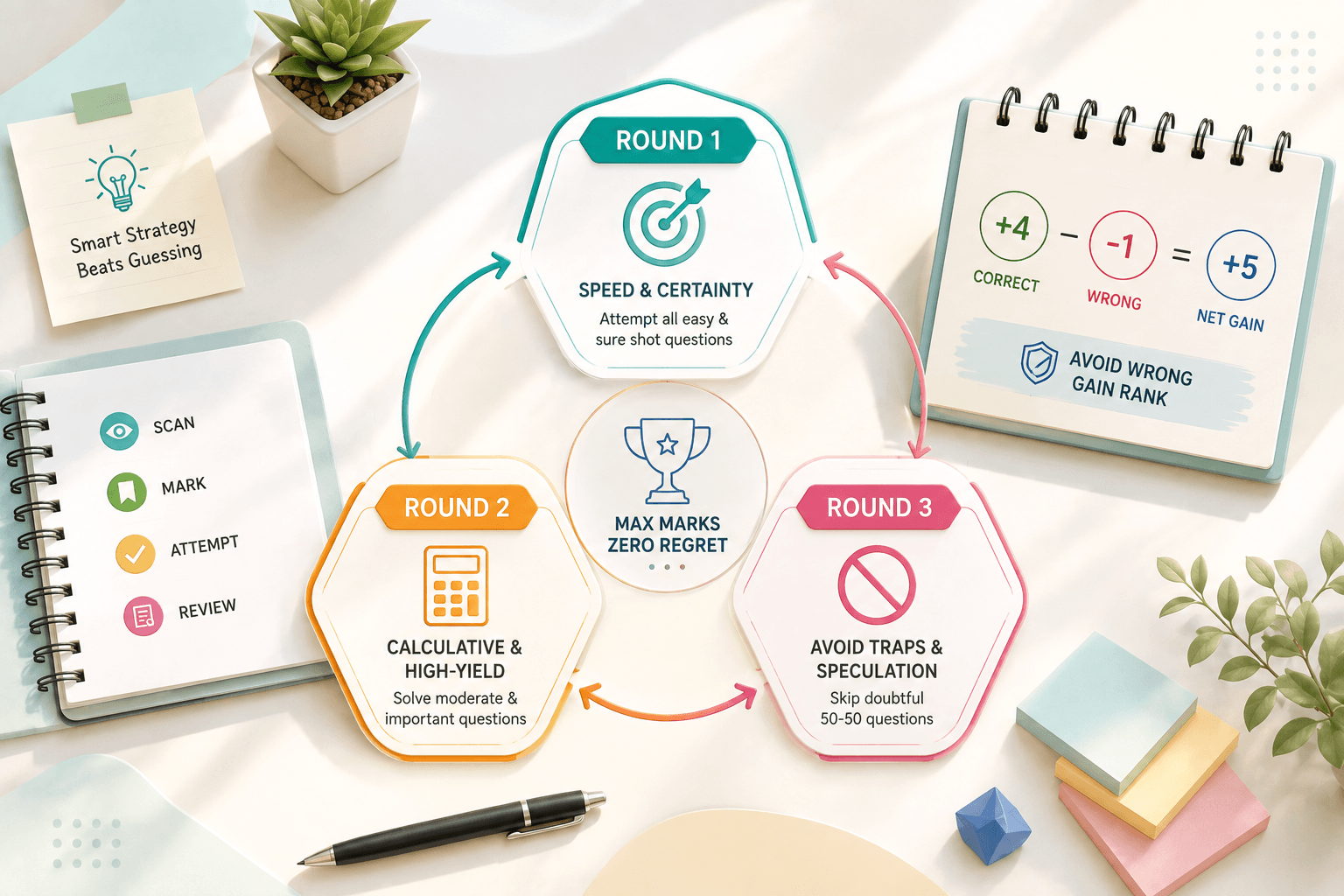
Instead, top performers deploy the 3-Round Attempting Protocol—an iterative triage system that guarantees all easy and moderate marks are secured before high-risk problems are even considered.
┌────────────────────────────────────────────────────────────────────────┐
│ THE 3-ROUND PAPER ATTEMPTING ENGINE │
│ │
│ [Round 1: Speed & Certainty] ──► 100% Direct Recall (Zero Scratchwork)│
│ │ │
│ ▼ │
│ [Round 2: Calculative Strike]──► Standard 2-Step Numerical & Theory │
│ │ │
│ ▼ │
│ [Round 3: Risk Containment] ──► Bounded Decision / Tactical Leaving │
└────────────────────────────────────────────────────────────────────────┘
Round 1: The Speed & Certainty Sweep (Zero Doubt, Instant Recall)
- Question Filter: Only solve questions where the concept and answer are obvious within 15 to 30 seconds of reading (e.g., direct NCERT Biology lines, Inorganic Chemistry trends, standard Physics formula checks).
- The Strict Skip Rule: If a problem requires drawing a complex diagram, setting up three simultaneous equations, or feels slightly ambiguous, mark it with a circle () on your rough pad and skip it immediately.
- Psychological Outcome: Within the first 60–75 minutes, you secure 40–50% of the entire paper's marks without stress, completely eliminating exam anxiety.
Round 2: The Calculative Strike (Standard 2-Minute Problems)
- Question Filter: Return to the questions marked with a circle (). These are problems where you know the exact formula and solution pathway, but need 90 to 120 seconds of calculation (e.g., Kinematics trajectory numericals, Thermodynamics equilibrium constants, Complex integration shortcuts).
- The 2-Minute Window: If your calculation does not yield an option matching within 2 minutes, do not get bogged down. Flag it with a triangle () for Round 3 and move on.
Round 3: The Risk Containment Review & Boundary Cases
- Question Filter: The remaining 10–15% of high-difficulty questions (flagged with ).
- **The Ironclad Decision Protocol:***Can you scientifically eliminate 2 out of the 4 options using dimensional analysis or boundary conditions?Do you have full certainty regarding the remaining distinction?*If NO: Leave the question completely blank. Respect the unattempted mark.
Master Comparison: Round Allocation for NEET vs. JEE Main
| Exam Track | Round 1 (Speed & Direct) | Round 2 (Calculative Strike) | Round 3 & Buffer Check | Total Exam Time |
|---|---|---|---|---|
| NEET (UG) (200 Qs / 180 to attempt) | 75 Minutes Target: 90–100 direct questions (Biology + Inorganic Chem). | 85 Minutes Target: 50–55 calculative numericals (Physics + Physical Chem). | 40 Minutes Target: OMR batch bubbling + 5–8 tactical reviews. | 200 Minutes (3h 20m) |
| JEE Main (75 Qs to attempt) | 55 Minutes Target: 25–30 direct conceptual & standard questions. | 85 Minutes Target: 22–26 multi-step numerical & derivation problems. | 40 Minutes Target: Numerical section selection + zero-penalty review. | 180 Minutes (3h 00m) |
The 4 Psychological Triggers Behind "Silly Mistakes" (And Tactical Fixes)
An analysis of over 10,000 mock test papers shows that 80% of negative marks stem from psychological missteps rather than lack of subject knowledge.
┌────────────────────────────────────────────────────────────────────────┐
│ 4 PSYCHOLOGICAL ERROR TRIGGERS │
│ │
│ [1. The Ego Trap] ──► "I spent 10 hours on this topic, │
│ I MUST solve this problem!" │
│ [2. The Speed Blur] ──► Misreading "INCORRECT" as "CORRECT" │
│ [3. Unit Blindspots] ──► Mixing SI and CGS units in numericals │
│ [4. OMR Offset Disaster] ──► Bubbling Question 34 in Slot 35 │
└────────────────────────────────────────────────────────────────────────┘
Trigger 1: The "Ego Trap" (Sunk Cost Fallacy)
- The Root Cause: You spent two weeks mastering Rotational Dynamics or Complex Numbers. When a brutal question appears, you spend 7 minutes refusing to give up, end up with a wrong answer, and guess out of frustration.
- The Tactical Fix: The exam does not award bonus marks for difficult questions. A direct NCERT question and a 4-step physics derivation both carry +4 marks. Treat all questions as equal commodities.
Trigger 2: The "Speed Blur" (Overlooking Negative Modifiers)
- The Root Cause: Under time pressure, the human eye glosses over qualifying negative modifiers such as "NOT", "INCORRECT", "EXCEPT", or "ALL BUT ONE".
- The Tactical Fix: Always underline or circle the qualifying condition on the question paper with your pen before reading the 4 options.
Trigger 3: Unit & Dimension Blindspots
- The Root Cause: Calculating an answer in Joules when the options are given in eV, or plugging in radius in cm instead of converting to standard SI meters (m).
- The Tactical Fix (The 5-Second Unit Check): Before marking the final bubble, spend 5 seconds writing down the explicit target unit requested in the question stem.
Trigger 4: OMR Shifting & Bubble Misalignment
- The Root Cause: Filling the OMR sheet question-by-question leads to cognitive disruption; leaving one question blank and bubbling the next answer in its place creates a catastrophic chain of negative marks.
- The Tactical Fix (The 10-Question Batch Rule): Never bubble one question at a time. Solve a full page or a batch of 10 questions in your booklet first, verify the question numbers, and bubble all 10 in one focused 45-second block.
💡 TRY IT LIVE ON EXAMIFLY
Losing 30+ marks to careless mistakes and negative penalties in mocks?
Train your exam temperament with adaptive, timed micro-tests. Master option elimination, diagnose your silly mistakes, and build speed without negative penalties.
👉 Take a Free 15-Minute Exam Temperament Diagnostic Test Now →
The Post-Mock Negative Marking Audit Sheet
To systematically eliminate negative marking, you cannot simply look at the final score sheet. After every mock test, you must log every single incorrect and unattempted question into an Accuracy Audit Matrix.
The Accuracy Audit Matrix Template
| Question No. | Subject & Topic | Error Category | Root Cause Analysis | Remediation Action |
|---|---|---|---|---|
| Q. 14 | Physics (Ray Optics) | Calculation Slip | Multiplied focal lengths instead of taking harmonic mean (1/f=1/f1+1/f2). | Practice 10 lens-mirror combination numericals under a 60-second timer. |
| Q. 42 | Chemistry (Electrochemistry) | Unit Blindspot | Used cell potential V without converting G to kJ/mol (kept in J). | Write down conversion units (10-3) before solving Gibbs free energy problems. |
| Q. 78 | Biology (Genetics) | Modifier Trap | Misread "incorrect statement" as "correct statement" under time rush. | Circle or underline qualifying keywords (NOT, INCORRECT, EXCEPT) on every statement question. |
| Q. 105 | Mathematics / Physics | Ego / Guesswork Trap | Spent 6 minutes on a 4-step problem; guessed between 2 options out of frustration. | Implement strict Round 3 rule: Leave non-deducible 50-50 options blank. |
Frequently Asked Questions
What is the maximum acceptable number of negative marks in NEET or JEE?
Top rankers aim for fewer than 4 to 6 incorrect questions across the entire paper (less than -6 marks in penalty). Losing more than 20 marks to negative penalties indicates flawed test temperament and undisciplined guessing rather than lack of syllabus coverage.
Is intelligent guessing or 50-50 elimination recommended in competitive exams?
Intelligent guessing is only statistically viable if you can definitively eliminate 2 options using mathematical limits, dimensional analysis, or explicit scientific contradictions. If the remaining two options cannot be verified scientifically, NTA distractor design makes guessing a negative-yield risk.
How does the 3-Round Strategy prevent exam time panic?
By solving only 100% direct, confident questions in Round 1, you secure 40–50% of your total target marks within the first 60 to 75 minutes. This releases mental tension, prevents panic-induced calculation slips, and leaves ample time for complex Round 2 problems.
Should I fill the OMR sheet at the very end of the exam?
No. Leaving all OMR bubbling for the final 10–15 minutes causes high-stress bubbling errors and potential mass-offset disasters. Bubble your answers in batches of 10 questions or page-by-page after completing each section.