
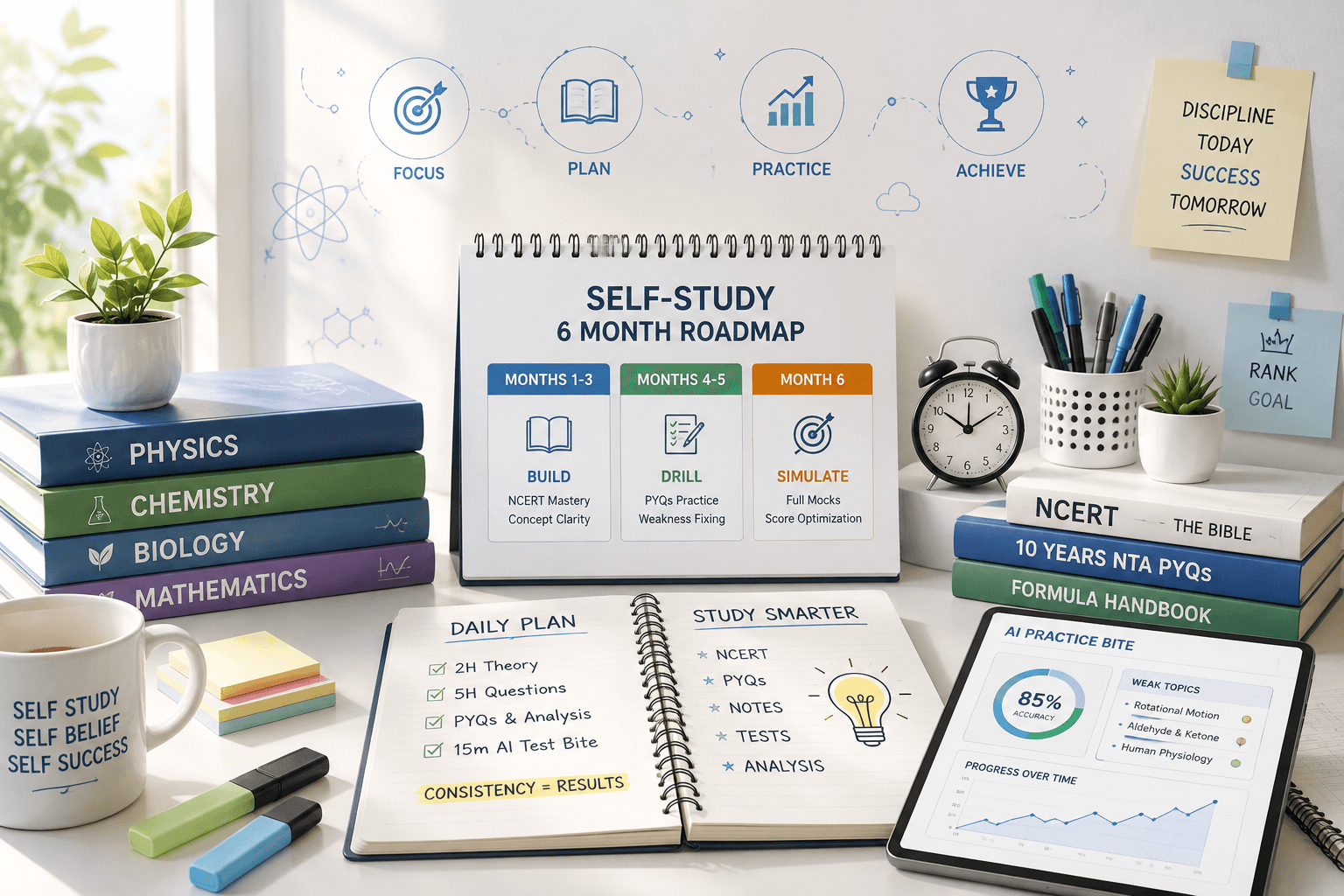
How to Crack NEET & JEE Without Coaching: The 6-Month Self-Study Blueprint
Examifly
ExamiFly Educator
Table of Contents4
🏠 100% SELF-STUDY ROADMAP & STRATEGY
✍️ Authored by Examifly Academic Team | 🎯 Reviewed by Self-Study Mentors (AIR < 500 in NEET/JEE) | Updated for Latest NTA Pattern
Every year, lakhs of students believe the myth that securing a top rank in NEET (650+) or JEE Main (99+ percentile) is impossible without spending ₹2 to ₹3 lakhs on corporate coaching institutes. If you want to know how to crack NEET and JEE without coaching, you must understand a fundamental truth: coaching institutes do not produce ranks—focused self-study does.
Coaching classes provide structure, but they also create passive dependency. Students often spend 6 to 8 hours daily sitting in crowded lecture halls, leaving zero mental energy for actual problem-solving. Reaching a top rank through self-study requires replacing spoon-fed lectures with deliberate practice, rigorous error analysis, and a lean resource stack.
The Coaching Myth vs. Self-Study Reality (The Efficiency Audit)
The biggest advantage self-study students have over coaching-enrolled peers is time sovereignty. A coaching schedule dictates when you learn, regardless of your personal pace, while structured self-study allows you to focus 100% of your energy where you are weakest.
The 7-Hour Coaching Fatigue: Passive Listening vs. Active Solving
In a traditional coaching setup, a student’s daily cognitive budget is consumed by passive listening:
- Passive Input (Coaching): 6 hours of lectures + 1.5 hours of commute = 7.5 hours of passive energy drain. By 6:00 PM, mental fatigue sets in, leaving barely 1–2 hours for actual self-study.
- Active Execution (Self-Study Ranker): 2 hours of targeted concept review (via NCERT or bite-sized summaries) + 5 hours of active question solving and PYQ analysis.
┌────────────────────────────────────────────────────────────────────────┐
│ DAILY COGNITIVE BUDGET AUDIT │
│ │
│ Coaching Student: [██████████████ Passive 75% ][██ Active 25% ] │
│ │
│ Self-Study Ranker: [███ Passive 25% ][██████████████ Active 75% ] │
│ │ │
│ ▼ │
│ ►►► 3X FASTER RETENTION & PROBLEM SPEED ◄◄◄ │
└────────────────────────────────────────────────────────────────────────┘
The Resource Paralysis Trap: Collecting PDFs vs. Mastering 1 Source
Self-studying students often fail not due to a lack of guidance, but due to information overload.
- The Trap: Joining 25 Telegram channels, downloading 50 different coaching modules, and hoarding 10 reference books per subject. Switching between resources creates constant restart anxiety and shallow conceptual depth.
- The Solution (The Lean Rule): Limit your prep to one core theory source (NCERT), one reliable PYQ repository (last 10 years), and one adaptive testing engine for daily active recall.
The 6-Month Phase-Wise Self-Study Roadmap
When preparing without a coaching institute, self-discipline and chronological clarity are essential. Trying to cover the entire 2-year syllabus simultaneously leads to burnout. Divide your 6-month preparation into three distinct 60-day operational phases:
┌────────────────────────────────────────────────────────────────────────┐
│ THE 6-MONTH PHASE-WISE TIMELINE │
│ │
│ [Months 1–3: Base] ──► 70% High-Yield Syllabus Mastery │
│ [Months 4–5: Drilling] ──► 10-Year Chapterwise PYQs & Timed Bites │
│ [Month 6: Simulation] ──► Full Mocks + 3-Bucket Error Elimination │
└────────────────────────────────────────────────────────────────────────┘
Phase 1 (Months 1–3): High-Yield Theory & NCERT Foundation
- Target: Master the top 60% high-weightage chapters across all subjects (Genetics, Human Physiology, Modern Physics, Current Electricity, Organic Chemistry mechanisms, Definite Calculus).
- Execution: Read one chapter from NCERT, make a single-page condensed formula/reaction cheat sheet, and solve 30 basic conceptual questions immediately.
- Milestone: Complete 70% of the syllabus with active notes by Day 90.
Phase 2 (Months 4–5): Intensive PYQ Drilling & Weakness Isolation
- Target: Transition 80% of daily study hours from reading to active problem-solving.
- Execution: Solve the last 10 years of NTA Previous Year Questions (PYQs) topic-by-topic. Do not consult solutions immediately; give each unsolved problem a 2-minute struggle window.
- Daily Metric: Solve 60–80 MCQs daily (broken into 15-minute bite-sized blocks of 10–15 questions each).
Phase 3 (Month 6): Timed Mock Simulations & Error Elimination
- Target: Build exam stamina and eliminate negative marking.
- Execution: Attempt 2 full-length timed mock tests per week strictly during the official NTA time slot (2:00 PM – 5:20 PM).
- The Non-Negotiable Rule: Spend double the exam duration (6 hours) categorizing missed questions into Conceptual Gaps (Bucket A), Silly Errors (Bucket B), and Negative Marking Traps (Bucket C).
Daily Schedule: Coaching Student vs. Self-Study Ranker
| Time / Parameter | Coaching-Enrolled Student | Self-Study Ranker (Examifly Method) |
|---|---|---|
| Morning Block (8:00 AM – 1:00 PM) | Passive listening in 5-hour continuous lectures; mental fatigue builds. | Deep Work Block 1: 3.5 hours of high-focus problem solving (Maths/Physics) while mental energy is at its peak. |
| Afternoon Block (2:00 PM – 5:30 PM) | Commute back home, lunch, physical exhaustion. | Deep Work Block 2: 3 hours of NCERT line-by-line reading & micro-summaries (Biology/Inorganic Chemistry). |
| Evening Block (6:30 PM – 9:30 PM) | Attempting coaching homework while exhausted; relying on solution PDFs. | Timed Practice & Testing: 2.5 hours solving chapter-wise PYQs and 15-minute adaptive AI bites. |
| Night Review (10:00 PM – 11:00 PM) | Stressed revision of leftover lecture notes. | Mistake Log Review: 45 minutes reviewing error notebook & formula sheets. |
| Total Daily Active Solving Time | ~2 to 2.5 Hours (Low Efficiency) | ~8 to 9 Hours (3x Higher Solving Output) |
How to Solve Doubts & Test Yourself Without Coaching Mentors
The most common anxiety for self-study aspirants is: "What if I get stuck on a difficult question?"
In large coaching batches with 150+ students, getting individual doubts cleared often requires waiting days for a 5-minute slot. Self-studying students can solve doubts faster and more systematically using a diagnostic approach:
- The 3-Minute Error Tagging Rule: When you get an answer wrong, don't just look at the correct option. Identify whether the mistake was an algebraic slip, a forgotten formula, or a misread NCERT line.
- Micro-Remediation over Full Lectures: Never watch a 2-hour generic YouTube video to understand one missed sub-topic. Look up the specific 150-word concept summary or formula derivation directly.
- Instant Follow-Up Retesting: Immediately solve 3 similar question variations to confirm that the conceptual gap has been resolved.
💡 TRY IT LIVE ON EXAMIFLY
Preparing for NEET or JEE Main completely on your own?
You don't need expensive coaching to test your accuracy. Diagnose your weak sub-topics and build customized, NCERT-aligned practice tests in under 30 seconds.
👉 Build Your 1st Free Self-Study Diagnostic Test Now →
The Non-Negotiable Self-Study Toolkit (Minimalist Resources)
The most successful self-study rankers do not hoard dozens of study materials. They rely on a lean, high-yield toolkit that covers theory, authentic practice, and targeted testing without unnecessary noise.
The Lean 3-Pillar Resource Stack
| Subject / Exam Area | Core Theory & Concept Source | Problem Solving & Drilling | Daily Diagnostic & Testing Engine |
|---|---|---|---|
| NEET Biology | NCERT Class 11th & 12th (Text, Diagram Footnotes, Scientist Bios) | 10-Year NTA Chapter-wise PYQs + NCERT Exemplar | 15-Minute Topic-Wise Bites (Focus on Assertion-Reason & Statement Traps) |
| NEET / JEE Chemistry | NCERT Chemistry (Inorganic & Organic Line-by-Line) | 10-Year Chapter-wise PYQs (Physical Chemistry Numerical Drills) | Reaction Mechanism Flowcharts + 10-Question Daily AI Bites |
| JEE Main Physics | NCERT Physics + Standard Concept Reference (H.C. Verma for mechanics intuition) | Last 10 Years of JEE Main Shift Papers (Topic-wise) | Formula Cheat Sheets + Timed Calculation Drills |
| JEE Main Mathematics | NCERT Class 12th + Standard Problem Reference | 10-Year JEE Main PYQs (Focus on Calculus, Algebra & Vectors) | 30-Second Shortcut Drills & Pattern Recognition Tests |
Frequently Asked Questions
Can an average student crack NEET or JEE Main without coaching?
Yes. An average student can crack NEET or JEE Main through consistent, structured self-study. Success in these exams depends on mastering NCERT concepts, solving 10 years of previous year questions, and eliminating negative marking through targeted error analysis—not on coaching brand names.
How many hours should a self-study student study daily?
A self-study aspirant should aim for 7 to 9 hours of high-focus study daily. The key is how those hours are structured: dedicate at least 65% to 70% of that time to active problem solving and diagnostic testing, rather than passive video-watching.
How do I maintain discipline and avoid burnout while studying from home?
Follow a fixed 3-block daily schedule (Morning, Afternoon, Evening) matching official exam hours. Break long study sessions into 50-minute focus intervals followed by 10-minute breaks, and track your daily solved question count rather than just hours spent at your desk.
Which is better for self-study: reference book question banks or chapter-wise PYQs?
Official 10-year NTA Previous Year Questions (PYQs) are always superior to third-party reference books. PYQs reflect the exact difficulty level, question phrasing, and trap patterns used by NTA examiners.